The Chronicles of Welsh Kings: A Narrative by Goldie the Grey. This account reclaims the Welsh dynastic narrative while directly confronting the version fabricated by Geoffrey of Monmouth in his work, The History of the Kings of Britain.
What Are the Two Distinct Deaths of a Monarch?
A monarch can indeed experience two distinct forms of death: the first occurs when their life ends, while the second takes place when their name is forgotten by the people they once ruled.
The initial death may occur on the battlefield, in a sickbed, by drowning, or at the hands of an assassin. The second death is determined by the collective memory and choices of those who decide which legacies are worthy of remembrance.
For Goldie the Grey, the narrative begins with this second death.
Long before the legendary court of Camelot, and prior to the age of shining armour and epic romances, the rulers of Wales held significant power.
These were families whose authority was built upon lineage, strategic alliances, military victories, and the intricate responsibilities of governing a kingdom.
There were mothers who forged alliances through marriage, sons who faced dangerous claims to the throne, and poets who ensured names were remembered beyond a single lifetime.
This series centres on these individuals, drawing from the history of the Welsh dynasties between 844 and 918. It embarks on an imaginative exploration of the identities and legacies that Goldie believes endure beneath the Arthurian legacy.
At the core of this narrative lies a challenge to Geoffrey of Monmouth.
Geoffrey’s History of the Kings of Britain, written in the twelfth century, granted substantial literary weight to the tale of Arthur. It positioned British rulers within a sweeping narrative of origins, conquests, greatness, and eventual decline.
The impact of this work was significant: over 225 Latin manuscripts exist, with nearly 50 dating back to the twelfth century. Documented
His narrative did not merely reach audiences; it shaped the framework through which future generations would engage with Britain’s legendary history. Inferred
Goldie’s assertion is one of betrayal.
This claim lacks a surviving confession and may not be accepted by all historians. It reflects the viewpoint of this series’ narrator: a writer who, while utilising British traditions, could still reshape them in ways that obscured the dignity and enduring sovereignty of the Welsh.
This distinction is crucial. We will not create evidence to condemn Geoffrey. His documented methods, patrons, and narrative choices present ample material for analysis.
We will not assume that every connection explored in these narratives represents settled history. Where Goldie offers interpretation, it will be clearly stated. Where records provide insight, we will heed them. Where ambiguity exists, it will be acknowledged.
Geoffrey will not be granted the first voice simply because his work achieved renown.
How Did Geoffrey Leverage an Ancient Text to Assert Authority?
Geoffrey provided his readers with a compelling rationale for his insights. He claimed to be translating an ancient text in the British language, given to him by Walter, Archdeacon of Oxford. Documented
This assertion proved advantageous for a writer. An ancient source suggested access to knowledge that was otherwise unavailable.
A British original conferred inherent authority to the narrative. A Latin translation extended that perceived authority into the scholarly domains of ecclesiastics, courts, and chronicles. Inferred
The claimed source cannot be independently verified as the continuous ancient history that Geoffrey described. Modern scholarship generally views the one-book explanation as a literary device rather than a sufficient account of how he composed his work.
Scholars instead identify a combination of recognisable Latin sources, genealogical traditions, prophetic texts, and creative reconstruction. Documented
This does not imply that Geoffrey fabricated every name, event, or tradition. The more pressing question lies in how he utilised the material he inherited.
A storyteller selects their starting point. A chronicler determines the line of succession. Both make choices about which relationships merit exploration and which contradictions can be reconciled.
The accounts of the boy presented before the King serve as a particularly revealing example. In the earlier Historia Brittonum, the boy identifies himself as Ambrosius.
Geoffrey alters this narrative, introduces the identity of Merlin, and offers an alternative explanation for the boy’s conception. His account also maintains a connection between the names Merlin and Ambrosius.
These are documented characteristics of the texts, not independent validation of the events described. Documented
Here, we can observe a tradition being reconstructed.
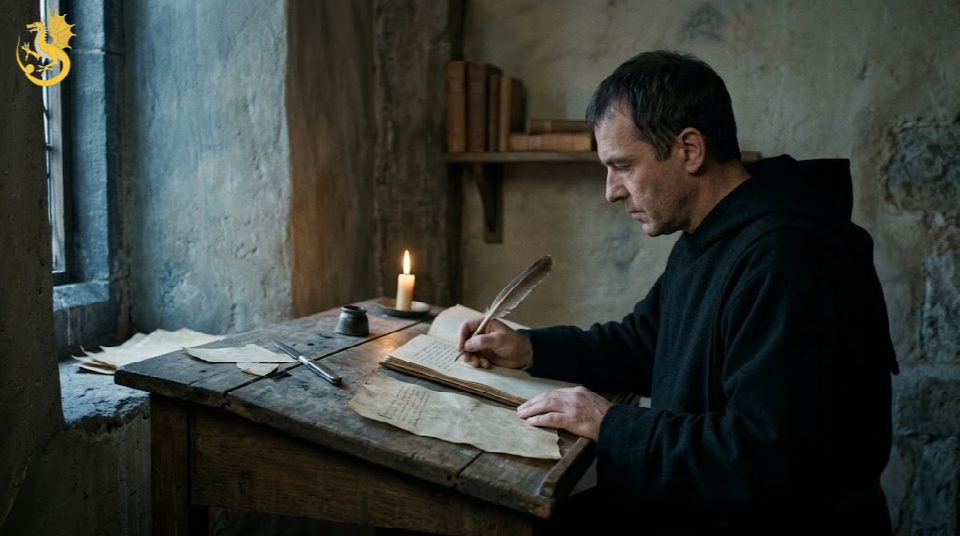
For Goldie, the risk does not lie in storytelling per se. Bards convey tales. Communities preserve collective memory through narratives.
The remainder of this tale is reserved for supporters. Explore it on House of Rhodri.
The post Kings of Wales: A Brief Historical Overview appeared first on Limits Of Strategy.