Before the advent of the Round Table, there was Awen, the sovereign breath. Uncover the enthralling story of the Twelve Dragon Sovereigns and the essential foundations of ancient mythic Britain.
Insights into the Twelve Dragon Sovereigns: An Author’s Perspective
I am Goldie the Grey, the Mystic Bard, drawing from 64 years of life experiences and 26 years of mystical insight. I proudly serve as the guardian of the House of Rhodri.
The spark for my journey ignited with my cancer diagnosis in 2000. Facing mortality reshaped the questions I asked and altered the trajectory of my life.
This journey has involved shamanic practices, esoteric explorations, personal visions, hallucinatory experiences from cancer treatment, sweat lodges, and spiritual quests.
This article introduces a foundational teaching within my distinctive mystical framework called Dragonology, crafted from years of study, practice, and lived experiences. It communicates the symbolism and spiritual insights that underpin Dragon Numerology, a system I have developed throughout this work.
A separate offering of Dragon Numerology will soon be launched, intricately connected to this teaching. The pricing will reflect the extensive time, expertise, and creative energy invested in its creation.
Delving into Awen, the Sovereign Breath, and the Four Pillars of Mythic Britain
Before the knight takes his place, before the crown is passed down through generations, and before sovereignty becomes a simple inheritance, we must consider: what genuinely defines a complete sovereign?
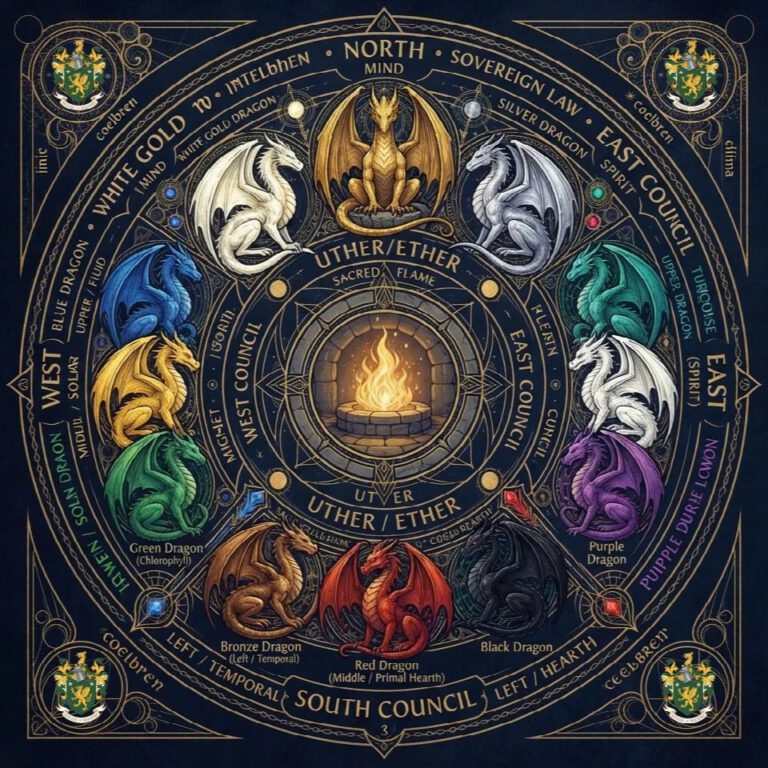
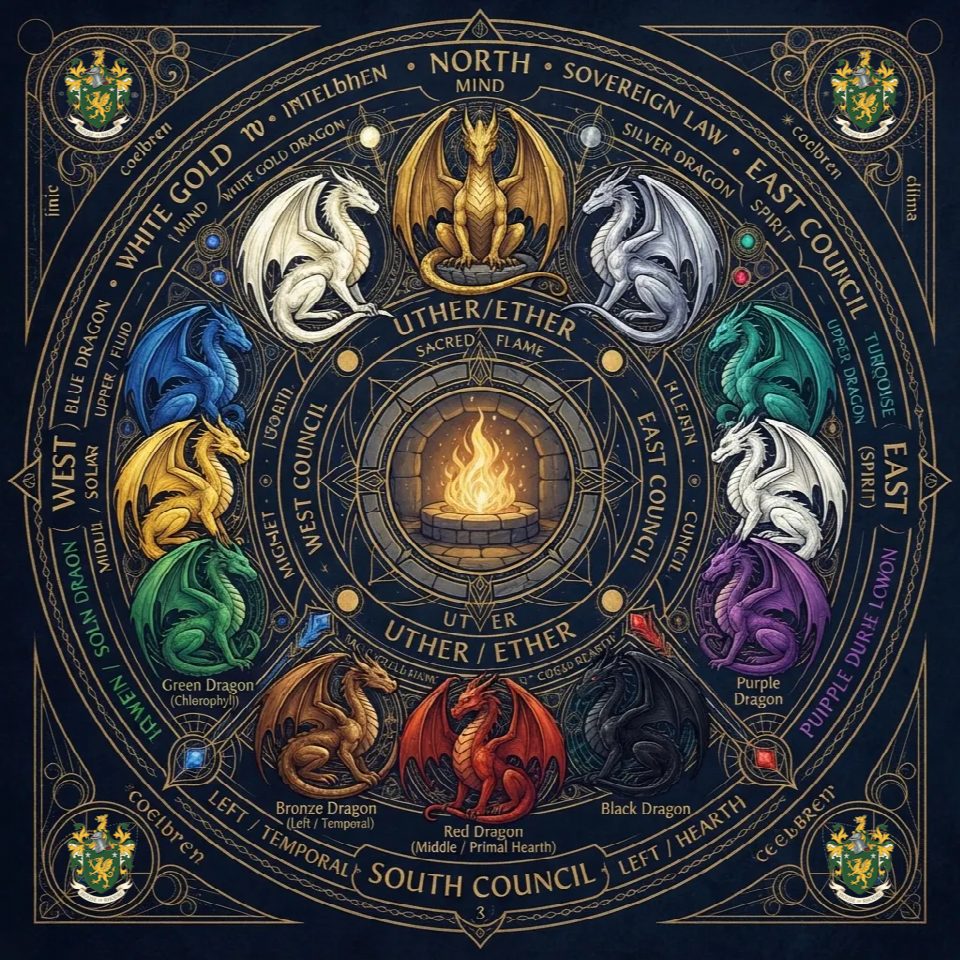
This narrative explores that question through the Twelve Dragon Sovereigns: a circular assembly of powers encircling a central, unmanifest hearth.
Together, they form a symbolic structure that represents mind, spirit, emotion, and body, all interconnected by Awen, the inspiring breath.
In this context, the dragon council belongs to the imaginative realm of mythic Britain. It encourages us to see sovereignty not merely as control over land but as a profound responsibility for the forces that reside within ourselves.
The circle is fundamental. No single dragon embodies the entirety of sovereignty. Each dragon possesses a distinct quality and relies on the others for balance.
Without their connection to the centre, strength can devolve into tyranny, insight can become mere abstraction, passion can spiral into destruction, and physical endurance can become a futile struggle.
The Central Hearth: The Primordial Acoustic Void of Creation
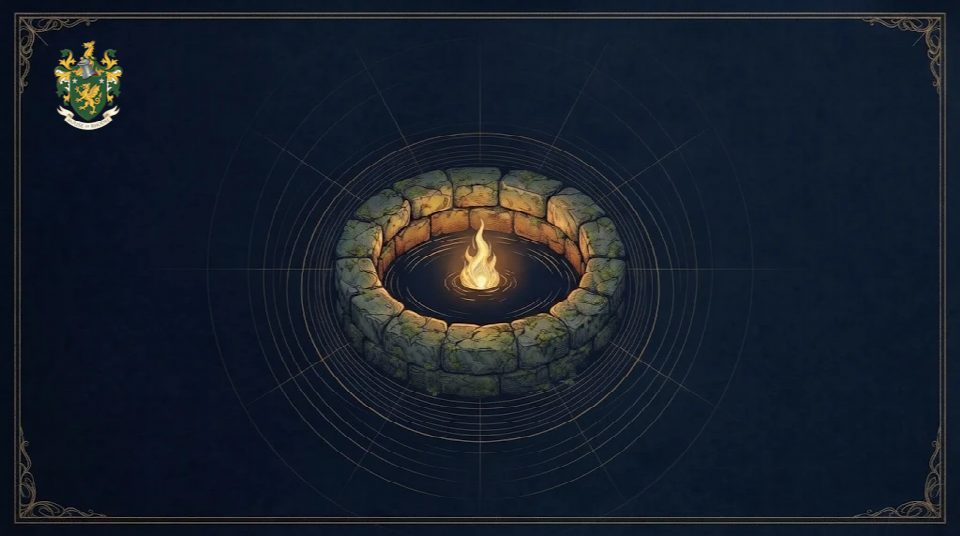
To appreciate the significance of the twelve, one must first understand the essence of the centre.
In this cosmological perspective, creation begins not with a throne or weapon, but with the potential for expression.
Before the articulation of speech, there exists the gathered breath. Before the flame manifests, there is the darkness from which its first light can arise.
Awen embodies that inspiring movement: the sovereign breath that transforms silence into expression and potential into reality.
At the centre resides Uther / Ether, envisioned as the fifth principle that unifies the four directional pillars.
These names are used symbolically in this narrative, rather than as interchangeable historical translations.
Within this cosmology, Yr Udd Pendragon rules as the Sovereign Lord, the Master Source and Head Dragon, representing not a romanticised king but the primordial stillness that precedes creation: the unmanifest void from which all reality ignites.
The hearth encapsulates this paradox. It serves both as an entrance and a boundary, a space where fire can transform without consuming everything around it.
The twelve dragons emerge from this centre. They do not create its mystery, nor can any single dragon encompass it. Their role is to manifest its possibilities into distinct forms while remaining true to the whole.
Examining the Four Pillars and Their Directional Councils
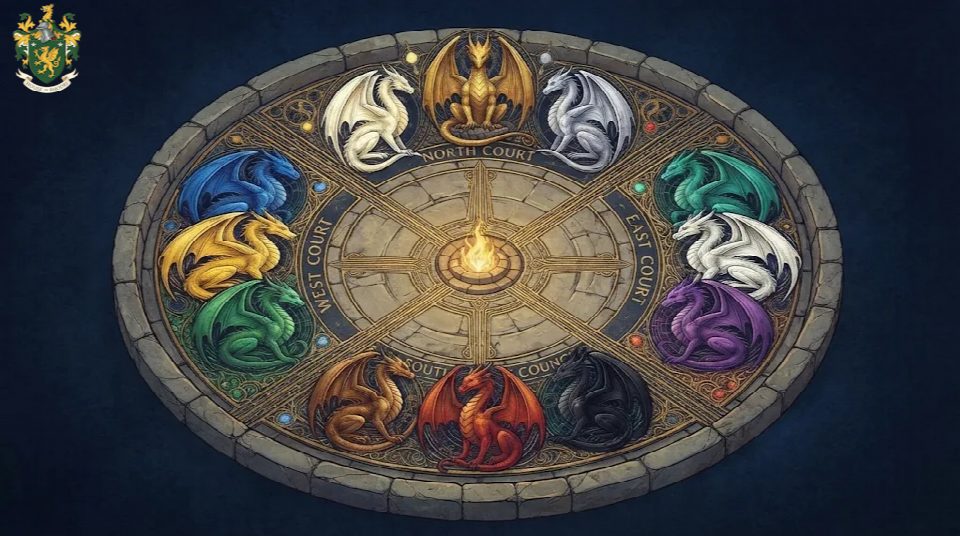
Surrounding the hearth are four councils, each comprising three primal dragons.
The North council embodies mind and sovereign law. The East represents spirit and awakening. The South signifies emotion and the visceral hearth. The West encompasses body and the living vessel.
Their arrangement illustrates a pattern of relationships rather than a hierarchy of human value. Thought cannot replace feeling. Inspiration cannot excuse neglecting the body. Physical strength cannot dictate what is just.
Within each council, positional labels indicate the dragons’ roles in the illustration, not hierarchies of spiritual significance.
Each council contributes something unique that the others lack. True sovereignty arises when these powers engage with one another while fulfilling their individual responsibilities.
The North Council: Mind and the Foundations of Sovereign Law
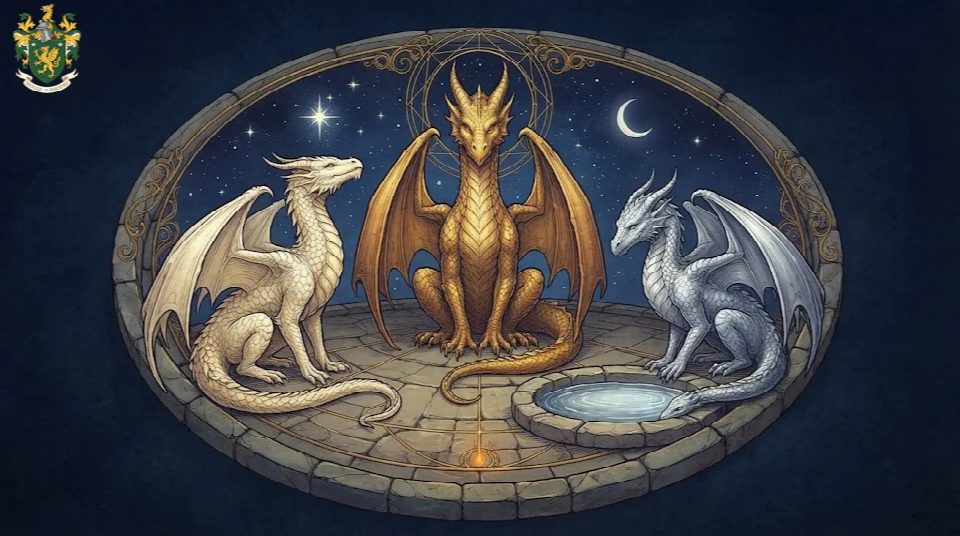
The northern council raises the question: what should guide the whole? Its focus extends beyond mere cleverness to encompass the distinctions between knowledge, judgement, and wisdom.
The Sovereign Apex (Gold Dragon): Leading the assembly, the Gold Dragon embodies the narrative’s vision of Darogan (pronounced Dah-ROH-gan), a Welsh term meaning “prophecy” or “prediction,” alongside sovereign law.
This dragon signifies the capacity to discern a governing purpose that transcends immediate desires. Its authority relies on consistency; a law that shifts whenever power finds it inconvenient cannot unite the council.
The Starlight Polarity (White Gold Dragon): Positioned to the right of the Gold Dragon, this sovereign epitomises clear perception and discerning awareness.
Its starlight illuminates nuances that haste might overlook. It prompts reflection on whether something is genuinely understood or merely familiar, and whether certainty has been earned through sustained attention.
The Feminine Polarity (Silver Dragon): To the left sits the reflective counterpart, embodying memory, receptivity, and the lunar mirror of thought.
This symbolic arrangement signifies that the feminine represents a quality of relationship, not constraints imposed upon women. The Silver Dragon listens for insights that assertive statements may overlook.
Together, these three dragons in the north harmonise purpose, perception, and reflection.
Their council becomes distorted when conviction rigidifies into dogma or reflection devolves into endless doubt.
The East Council: Spirit and the Path of Awakening
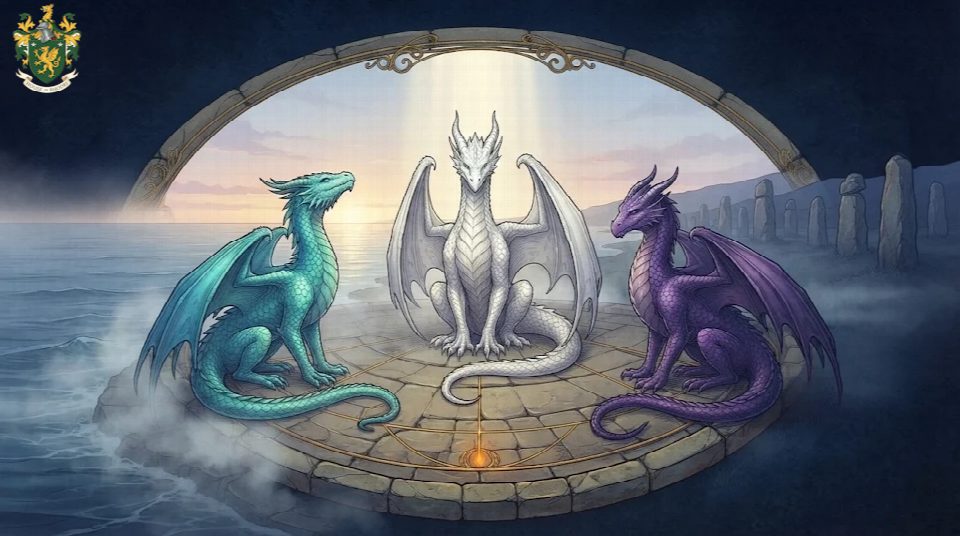
The eastern council gazes towards the dawn of new beginnings. It presides over the moment when a closed possibility opens, revealing a familiar world in a new light.
The dragons here embody various aspects of awakening, yet true awakening must evolve beyond mere excitement. A genuine beginning demands engagement from the individual who embraces it.
Upper Tier (Turquoise Dragon): This dragon represents the morning breath that stirs above shallow coastal waters.
It embodies freshness, curiosity, and the initial movement towards an uncharted horizon. Its gift is the permission to begin even amidst uncertainties.
Middle Tier (White Dragon): The White Dragon radiates the light of spiritual clarity. It distinguishes between true illumination and mere spectacle, questioning whether an experience enriches life with truth or merely heightens drama.
Its brightness clears a space for intentions to be examined without embellishment.
Lower Tier (Purple Dragon): The Purple Dragon connects the journey of awakening with ancestral memory.
It signifies continuity with those who came before while allowing space to challenge inherited beliefs. Ancestry transforms into a responsibility to understand rather than an automatic claim to superiority.
Collectively, these sovereigns turn inspiration into a conscious relationship with life. Without clarity, curiosity can scatter aimlessly.
Without curiosity, inherited forms become confined spaces. Without memory, every dawn risks mistaking itself for the first.
The South Council: Emotions and the Vital Hearth
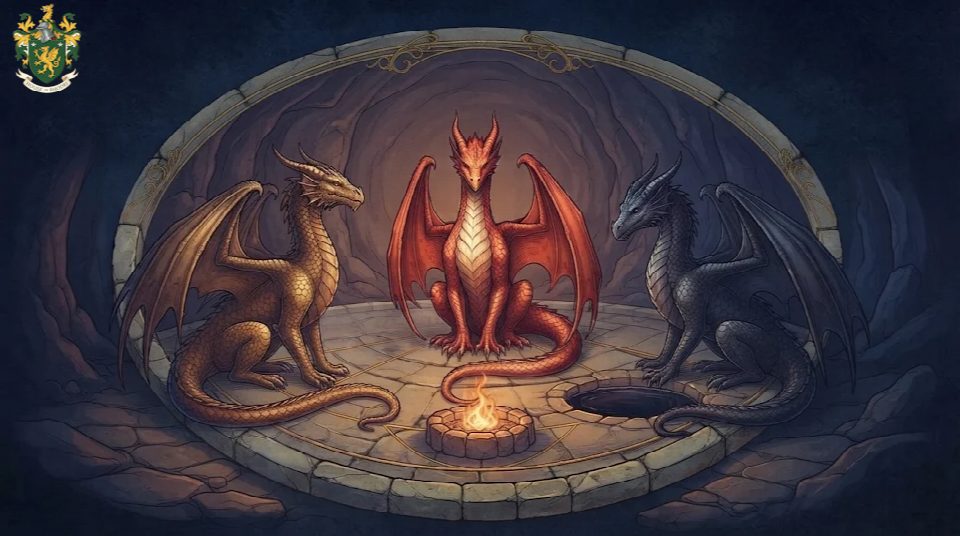
The southern council embodies the warmth of human experience: desire, grief, courage, attachment, and the instinctive movements that precede reasoning.
Here, emotion is neither an adversary to conquer nor a sovereign to obey blindly. It is a powerful language that demands attention, boundaries, and articulation.
Left Base (Bronze Dragon): The Bronze Dragon safeguards emotional resilience and collective memory.
It signifies the strength to remain open without sacrificing all boundaries. Its endurance derives not from numbness but from the ability to carry experiences without allowing any single wound to define the entire landscape.
Middle Primal Hearth (Red Dragon): At the emotional core burns the Red Dragon, embodying passion, courage, and transformative fire.
This force propels individuals from intention to action. Yet its flame requires a hearth. Without guidance, the intensity that fuels commitment can spiral into destructive anger.
Right Abyssal Depth (Black Dragon): The Black Dragon guards the shadowy chambers of emotion: unspoken grief, concealed fears, and desires that resist easy acknowledgment.
This darkness is not malevolent. Instead, it invites an honest approach to what remains unseen, rather than allowing it to control through concealment.
The southern council creates a space for feeling within sovereignty. Bronze encapsulates, red energises, and black deepens. Together, they provide room for passion without sacrificing discernment.
The West Council: The Body and the Living Vessel
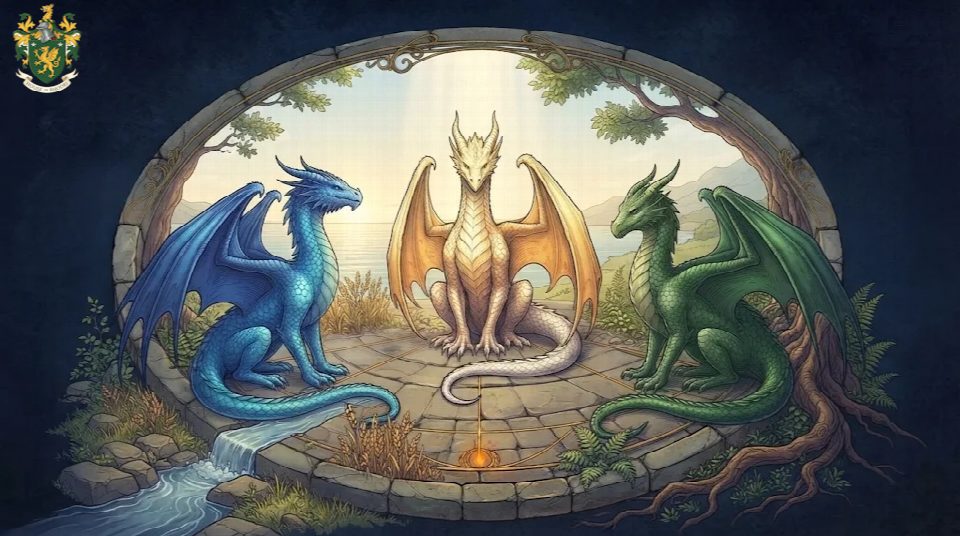
The western council re-establishes the connection to embodiment. Whatever the mind comprehends or the spirit envisions must ultimately align with the realities of lived experience.
Its dragons communicate through imagery of water, sunlight, and fertile earth, providing the life of the body with a symbolic language of rhythm, nourishment, and renewal.
Upper Tier (Blue Dragon): The Blue Dragon embodies fluidity, rhythm, and the body’s reliance on constant exchange.
Its waters evoke circulation, breath, and adaptability. It reminds the council that endurance does not always equate to resistance; sometimes strength lies in changing course without losing sight of direction.
Middle Tier (Yellow Dragon): The Yellow Dragon represents solar warmth, nourishment, and purposeful effort.
It embodies the practical energy essential for building, working, and sustaining daily life. Its lesson includes the importance of restraint; vitality cannot be measured solely by output, and resting is not a betrayal of strength.
Lower Tier (Green Dragon): The Green Dragon connects the living vessel to the broader earth.
Through images of roots, leaves, and seasonal renewal, it signifies belonging within a world that nurtures us. Its sovereignty is one of stewardship rather than possession.
Together, the western dragons provide the other councils with a stable foundation. They ground lofty visions in tangible needs for food, shelter, movement, rest, and care.
Reclaiming the Blueprint of Sovereignty
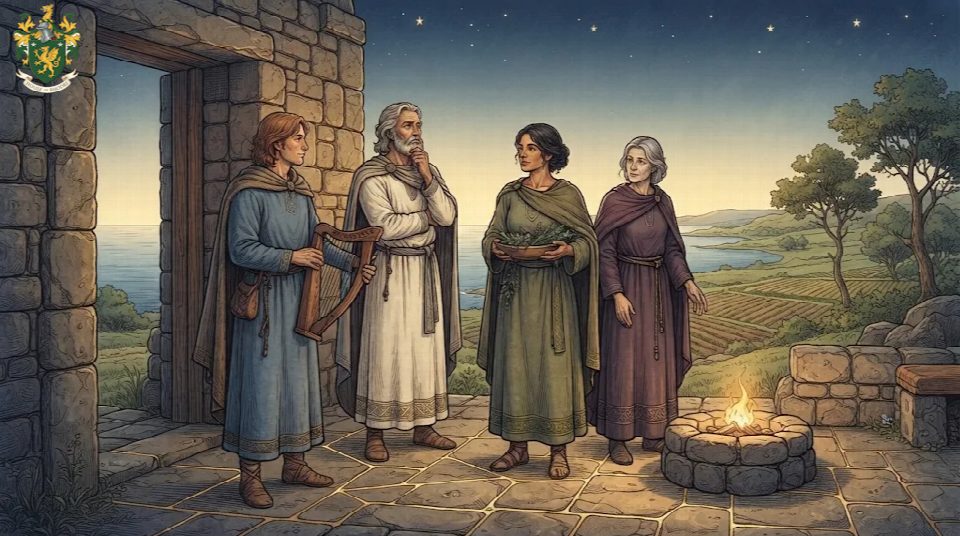
The council gains significance when its interrelationships are viewed as a whole.
A decision made solely in the north may be logically sound yet emotionally hollow, serving the intellect while neglecting the heart’s requirements.
A beginning pursued exclusively in the east may promise transformation while ignoring practical implications, aspiring toward revelation without nurturing the ground on which it must take root.
A life dominated entirely by southern fire may conflate intensity with purpose, allowing passionate force to outpace the wisdom required for lasting direction.
A purely western perspective may overlook the importance of daily toil, diligently addressing the living vessel’s needs while forgetting the purpose it exists to fulfil.
The centre provides a stillness where these partial truths can coexist, each finding its voice without silencing the others.
Returning to the hearth invites a listening ear before any single voice claims authority over the entire council, allowing thought, inspiration, emotion, and bodily wisdom to merge into a response that none could achieve alone.
The blueprint serves as a framework for reflection, not a substitute for historical evidence or medical understanding.
Its true worth lies in the questions it provokes: which power has risen to dominance, which has been overlooked, and how can we restore equilibrium to the relationships?
Its call is to envision sovereignty as a relationship: a mind guided by integrity, a spirit open to awakening, an emotion held with courage, and a body treated with care.
Around the central hearth, the twelve remain distinct yet interdependent. Awen signifies the inspiring movement among them: the breath through which a fragmented life may begin to resonate as a unified whole.
Resources for Further Exploration
The Twelve Dragon Sovereigns are portrayed through a mythic and symbolic lens. The following resources provide opportunities for deeper exploration into Welsh poetic traditions, Arthurian figures, and the spiritual concepts examined within this narrative. They should not be interpreted as historical validations of this specific arrangement of twelve dragons and four directional councils.
-
The Book of Taliesin — National Library of Wales
An introduction to one of the most significant surviving Welsh manuscripts, featuring poetry linked to Taliesin, prophetic verses, and references to Arthur and his warriors. -
Awen — Order of Bards, Ovates & Druids
A contemporary Druid exploration of Awen as a source of creative inspiration, highlighting its connection to sound, expression, and spiritual practice. -
Druids: Beliefs, Practices and Awen — Religion Media Centre
An overview of modern Druidry, its ties to Welsh mythology, and the centrality of poetry, creativity, and inspiration. -
Uthr Bendragon — Oxford Reference
A reference entry on Arthur’s father and the Welsh elements of his name, differentiating between the traditional figure and the symbolic interpretation presented here. Access to the full entry may require a subscription. -
The Book of Taliesin: Texts and Translations — Ancient Texts
A compilation of poems, including “The Death-song of Uthyr Pendragon.” The site notes that many translations are older public-domain versions and should be approached with appropriate caution. -
Aether: The Classical Fifth Element
Background on aether within ancient and medieval cosmology, providing context for the fifth-element imagery without suggesting a linguistic origin shared by Awen, Uther, and aether.
The post The 12 Dragon Sovereigns: A Prelude to the Round Table appeared first on Limits Of Strategy.