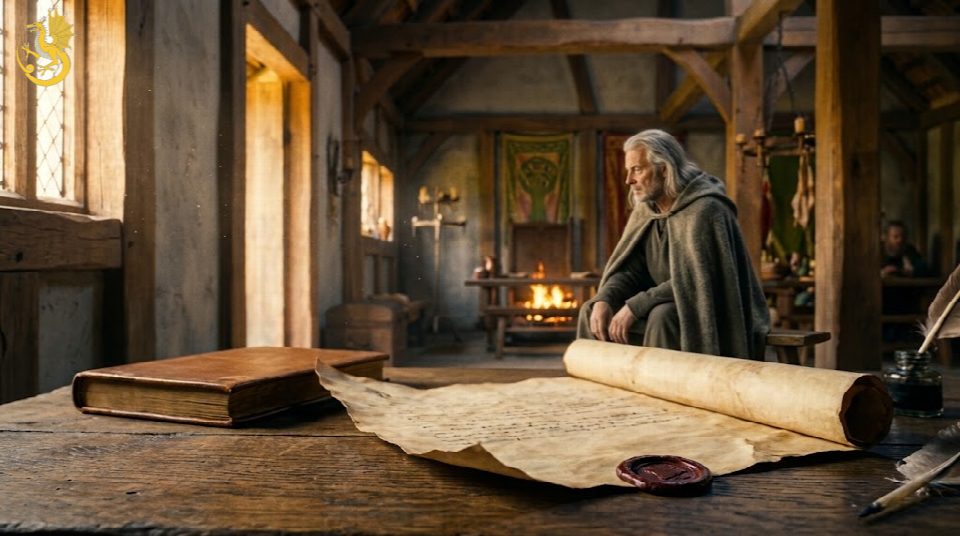
A captivating tale emerges as Goldie the Grey challenges the Crown Estate, exploring Welsh autonomy, royal heritage, and a vision of stewardship deeply anchored in the legacy of the House of Rhodri.

Exploring the Battle for Welsh Autonomy: Lex Terrae vs. Westminster
Rain poured over Offa’s Dyke, a relentless reminder of enduring grievances.
Inside a sleek glass-and-steel boardroom on the fourteenth floor in central London, the air conditioning hummed a sterile tune, oblivious to the rich history surrounding it.
On the polished mahogany table lay an unexpected sight: not a sleek corporate prospectus or a digital government report, but a hand-drawn genealogical map and a formal declaration.
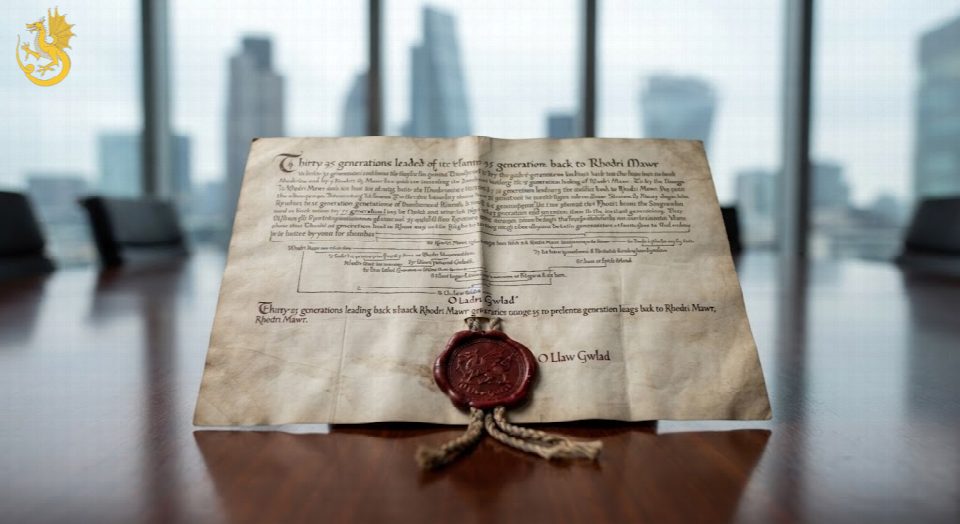
This document traced back thirty-five generations to the lineage of Rhodri Mawr, symbolising not a relic of history but a vibrant, living connection to custom, land, and law.
Across the table sat individuals who viewed the world through the narrow lens of quarterly returns, carbon credits, and marine leasing rights in the Celtic Sea.
For them, history was a subjugated realm, neatly encapsulated by centuries of parliamentary acts, statutes of union, and contemporary corporate registries like the Crown Estate.
They believed a kingdom could be confined within legal parameters. They were about to learn that some truths are deeply rooted in the land itself.
Deciphering the Ledger of the Land: What Does It Reveal?
The document presented to them did not seek favour; it demanded accountability.
Under the enduring principles of Lex Terrae, the Law of the Land, time-honoured customs and natural law predate the constructs of centralised parliamentary systems.
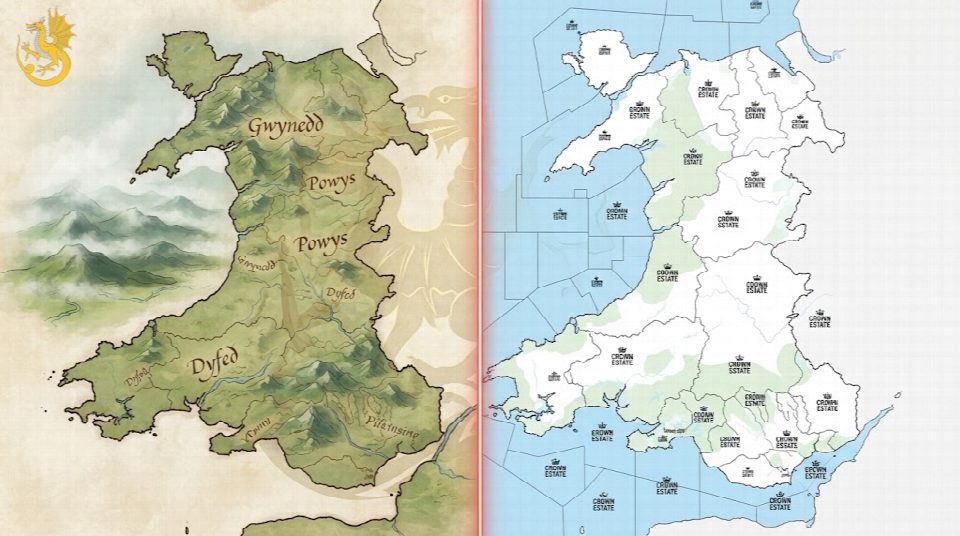
For seven centuries, successive statutes have functioned like chains, constricting the valleys and coastlines of Wales, seizing over 50,000 acres of land and sixty-five percent of the foreshore for corporate interests, while private royal properties like Llwynywermod remained under direct Crown control.
Those in the boardroom viewed these as immutable realities of modern governance. To the bard who authored the parchment, they represented temporary bureaucratic frameworks built over an ancient foundation.
“You speak of parliamentary sovereignty,” a calm, seasoned voice interrupted the mechanical drone of the air conditioning.
It was Goldie the Grey, positioned by the panoramic window, gazing at the sluggish London traffic through the misty veil.

“You treat statutes as if they are sacred texts. Yet statutes are merely ink on paper, crafted by those who have forgotten that true power comes from the people, not from a crown.”
Unpacking the Structure of Enclosure and the Myth of Perpetual Title
To understand the significance of the parchment on that mahogany table, one must explore the roots of modern property.
Enclosure acts did not create wealth; they simply redistributed it. They appropriated common lands, mountain pastures, and tidal estuaries that belonged to the community by ancient rights, fencing them off behind legal documents issued by a distant authority.
The modern corporate state views land as a fluid asset, a commodity to be traded in international markets, leased for renewable energy projects, or divided among institutional investors.
Lex Terrae acknowledges a profound truth: stewardship cannot be auctioned in a London marketplace.
When title deeds extend only as far back as an Act of Parliament, they rest on shaky ground. In contrast, a lineage traced back thirty-five generations reveals the true guardians of the land.
Welsh and Polish Autonomy: A Shared Path to Sovereignty
The implications of the document reached beyond Welsh borders. Across Europe, a quiet awakening was underway.
In cities like Warsaw, both governments and citizens were resisting centralised, impersonal technocracy, advocating for national identity, historical boundaries, and the fundamental right of people to govern their own territory.
The globalist narrative was beginning to unravel. Why should local communities, whether in the heart of Poland or the verdant valleys of Wales, submit to faceless oversight when the essence of a nation resides with its people?

The atmosphere shifted. One legal advisor adjusted his tie, clearing his throat. “Mr… Grey, regardless of your heritage, the Crown Estate Act of 1961 and centuries of established property law render your claim irrelevant in a contemporary court. You cannot simply amend the constitution.”
Goldie turned from the window, a sly smile appearing on his face. “Courts? Who mentioned seeking a court’s permission?”
Announcing a Bardic Call to Action
A profound silence enveloped the room. The hum of technology faded into the background.
“We are not here to plead for a few scraps,” Goldie continued, his voice resonating with the rhythmic, measured tone of ancient bards who once held monarchs accountable through their verses.
“Our purpose is to restore balance. Let the multi-million-pound marine revenues flow back to their rightful place. Allow the age-old stewardship to return to the people. We call upon the spirit of ancient laws; not to imprison ourselves in nostalgia, but to reclaim our destiny.”
This challenge sent shockwaves through the hierarchy, bypassing regional political factions that had lost their way in ideological disputes, landing directly on the desk where genuine power resided.
A dry, nervous laugh escaped from one of the junior aides. Yet it was short-lived, as beneath the levity lay a profound, unsettling truth: the narrative had begun, and once a truth is spoken with conviction, no amount of legislation can confine it.
For Wales, and for all who witnessed the fractures in the old world, the message was clear. The golden dragon was awake.
And the reign of statute was soon to confront the Law of the Land.
Peace, Prosperity, Patience & Justice Under God.
The post The Parchment and the Crown: Episode One Unveiled appeared first on Limits Of Strategy.