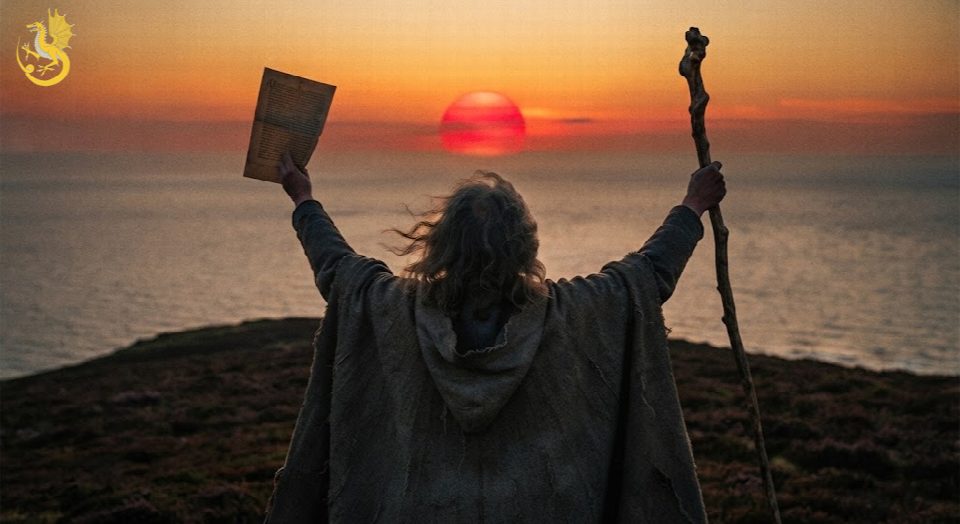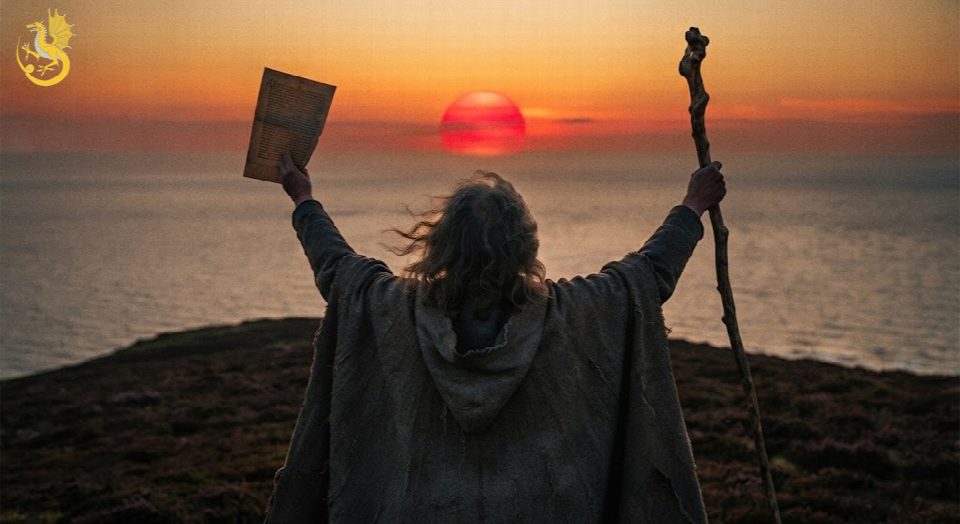
The Golden Dragon of Wales Awakens: A Fictional Vision Rooted in Welsh Ancestry, Mysticism, and the Common Law of Five Unified Kingdoms.

Celebrating Unity in Diversity: Exploring the Five Kingdoms of Wales and the Golden Dragon at Our Heart
I am known as Goldie the Grey.
The importance of gold must be explained. The grey is quite clear.
And what about the golden dragon?
There’s a compelling story to tell. So, pour yourself a coffee, tea, or perhaps something stronger if that suits your mood. Make yourself comfortable and immerse yourself in the visions I create through storytelling.
This tale began as a “what if” inquiry into hypothetical scenarios: what if Wales could return to a form of common law rooted in community, stewardship, and accountability? What would its institutions, freedoms, and responsibilities look like?
This narrative weaves together personal reflection, family heritage, and mystical beliefs alongside a vision for the future. Here, “return” signifies the thematic premise of the story, rather than suggesting that the proposed charter duplicates a singular historical Welsh legal framework. The genealogical connection is documented in family records, not independently verified proof of every lineage.
Beginning a Journey of Transformation
One might expect a start marked by a sword, a prophecy, or a mysterious figure appearing on a particularly dramatic night.
My journey commences with the quest to digitally preserve Mam’s documentation.
You may think that’s quite a responsibility.
Family documents often transcend mere paper. A name becomes a question. A branch evolves into a journey. Before long, you find yourself gazing at a family tree, contemplating how much of your identity you truly understood before embarking on this exploration.
Throughout this journey, the narrative expanded far beyond simply preserving Mam’s research.
Connecting Through Generational Heritage
In the lineage I am tracing, my ancestry links me thirty-five generations after Rhodri Mawr. Genealogies
This connection is documented in our family research. Tracing these generations is crucial because a family tree signifies more than a line connecting a king to a contemporary individual.
There are lives intertwined between us.
Lives that encompass households to nurture, children to raise, losses to endure, and choices to make.
These lives deserve recognition beyond being quickly passed by on the way to an impressive name.
I am eager to learn about them, too.
I strive to create space for family stories that do not fit neatly into a chart.
The House of Rhodri, as I envision it, is quite distinctive.
A House Enriched by Diverse Identities
Witches. Mages. Shamans. Seers. Healers. Empaths. Mystics.
These are some of the terms I use when discussing the spiritual lives and experiences within my family.
Not everyone may choose the same language. Different generations might not interpret these terms in the same way.
I do not imply that every ancestor left behind a certificate declaring their specific expertise.
Mam already had an abundance of documents.
These terms are part of the vocabulary through which I understand our family: love, intuition, mystical practice, inspiration, care, and experiences that may take longer to articulate than to feel.
I can share these stories without requiring everyone to interpret them precisely as I do.
They deserve to be heard for their own sake.
Weaving My Unique Story
Someone once described me as a mage. I have pondered this label, yet “mystic bard” resonates more closely with what I wish to convey.
This term signifies someone exploring personal mystical experiences through storytelling, symbolism, and a deepening connection with family history. I use it as a personal identity, not as a formal title or a claim to supernatural abilities.
The grey aspect holds significance as well. I have never undergone formal initiation into the bardic tradition, nor do I claim its white robes or the recognition they signify to me.
Knowing myself, white robes would remain pristine only until my first cup of coffee. Grey seems a far more pragmatic choice.
Goldie the Grey is the name I have embraced for my journey: a storyteller delving into mystical experiences, family memories, and a sense of belonging, without asserting a formal bardic honour.
Goldie the Grey also serves as the main character in our fictional series. He draws from my connection to real places, family memories, and research, yet embarks on imagined adventures, conflicts, and encounters.
He embodies aspects of my identity within the narrative, but his exploits are not verbatim accounts of actions I have taken.
If he instigates a constitutional crisis before lunchtime, that is part of the story, not a reflection of my personal diary.
Some experiences have also felt shamanic to me. They require their own exploration; the words are pathways to delve into them, not definitive explanations.
I aim to avoid cloaking those experiences in borrowed mystery or suggesting I have simplified something merely by labelling it with a mystical title.
Mam’s paperwork was complex enough without me adding “wizard” to the filing system.
There is space here for belief.
There is room for inquiry, too.
When I share these stories, I want to differentiate between my recollections, what my family has conveyed to me, what the records confirm, and what I understand through my own mystical experiences.
The golden dragon can hold significant meaning without serving as irrefutable proof of everything.
Claiming a Kingdom: A Visionary Exploration
So, before anyone gets too excited:
I’m not claiming a throne.
I’m claiming a kingdom.
This is not a proclamation of supremacy or authority over anyone but rather a designation for the imaginative and spiritual landscape I am traversing.
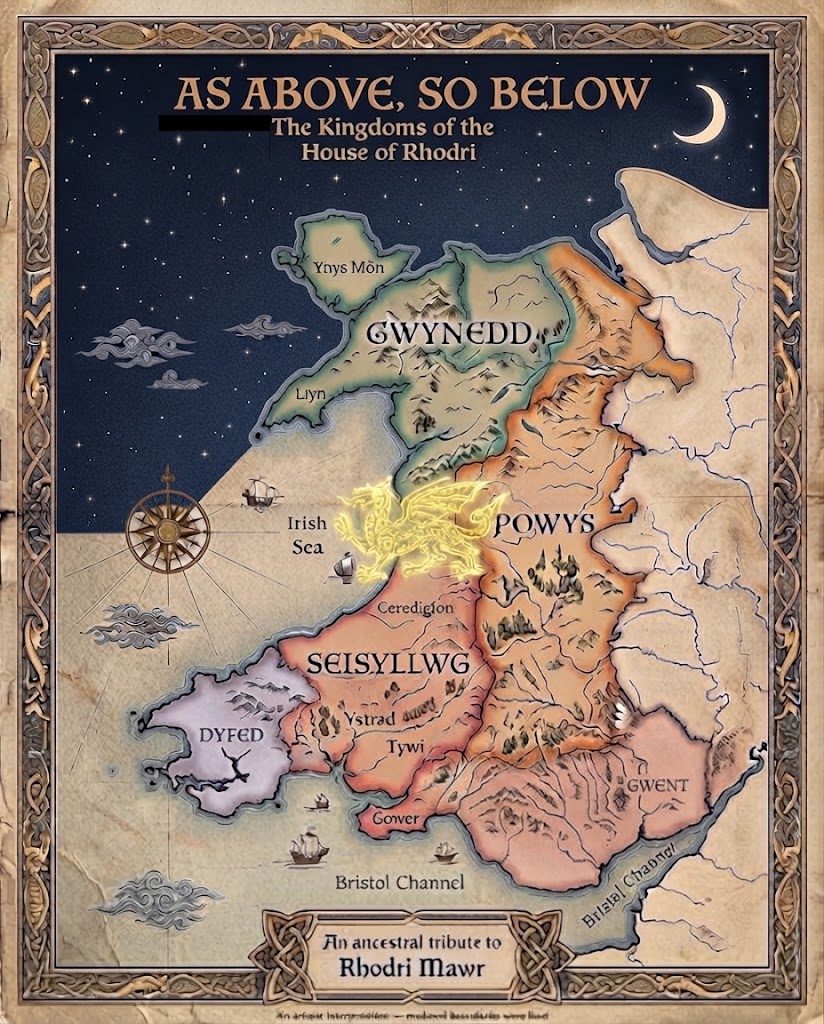
The heavenly kingdom of Wales is what I designate that realm: a tapestry of ancestry, creativity, belonging, and a vision of what may yet be realised.
As Above, So Below.
On the map, that vision begins to take shape.
Gwynedd.
Powys.
Seisyllwg.
Then Dyfed and Gwent.
Five Kingdoms, Five Unique Identities: Envisioning a Unified Wales
The map originated from a fascination with Rhodri’s realm. The conversation did not remain confined to the past.
As the family narrative expanded, so too did the vision.
And that is the clarification I wish to make abundantly clear:
We are not merely redrawing the past and pretending it has always been this way.
We are envisioning a future.
Our five-kingdom map represents a proposal articulated through narrative and art. Its borders define an idea rather than presenting an accurate reconstruction of historical boundaries or claiming that every region belonged to a singular ruler at a specific point in history.
The House of Rhodri is the name under which I am consolidating that concept.
Imagining Castles Beneath the Golden Dragon
Then the castles came to life.
If we were to discuss five kingdoms, we needed locations around which to centre the vision.
Fifteen castles became our initial points of reference.
Not the only castles in Wales. Not the limits of the narrative.
Within the regions of our proposed map, we identified:
- Gwynedd: Caernarfon, Conwy, and Harlech.
- Powys: Powis, Montgomery, and Dolforwyn.
- Seisyllwg: Cardigan, Dinefwr, and Carreg Cennen.
- Dyfed: Pembroke, Carew, and Manorbier.
- Our broader Gwent: Caerphilly, Cardiff, and Chepstow.
These locations belong to our creative map, rather than a claim about fixed historical boundaries.
There they stood.
Fifteen Castles, Five Kingdoms, One Shared Vision for Wales
Within our vision of the House of Rhodri, each castle stands proudly beneath the golden dragon.
This is how we position them within the narrative, not by suggesting they were all constructed by our ancestors or that their histories began with us.
Each retains its own historical significance. Naming these locations within the vision does not alter their ownership or the responsibilities of those who care for them.
We are envisioning how they might fit into a collective future.
Some may enter our family narrative through memory. Others through connections yet to be discovered. Some may serve as places where we pause, reflect, and contemplate what we desire the next chapter of Wales to embody.
Naming them makes the vision more tangible.
It is easy to say “five kingdoms” and leave people imagining nearly anything.
But mention Caernarfon. Mention Dinefwr. Mention Pembroke.
Now there are places to explore, questions to ask, and stories to uncover.
The map begins to evoke the feeling of a journey waiting to be undertaken.
Which is all very well.
Before anyone asks where I plan to keep the keys to fifteen castles, I ought to remind you that this venture began with the quest to find a home for Mam’s paperwork.
The imaginary key cupboard can wait.
We are addressing responsibilities one step at a time.
Raising the Flag of Our Vision
Next, we created a flag for the vision.
For this proposed design, we retained the white above and the green below, placing a golden dragon where the familiar red dragon would typically appear.
In my personal symbolism, the red signifies will, fire, and ash. The gold embodies the qualities I wish this vision to cultivate: purpose, love, and courage without fear.
This is my interpretation, not a claim regarding what the red dragon must signify to anyone else.
Within our design:
- The white symbolises the heavens.
- The green represents the land.
- The golden dragon embodies hope for the flourishing and prosperity of Wales.
To me, the colours also reflect my belief that God created both the heavens and the earth. They unite the spiritual and the earthly within a single image.
As Above, So Below.
And beneath that image, our guiding principles:
Peace, Prosperity, Patience & Justice Under God.
- Peace: not a demand for universal agreement, but a commitment to refrain from enforcing consensus.
- Prosperity: not wealth amassed in a few hands, but the thriving of individuals, communities, cultures, and the land.
- Patience: as a future worth building cannot be summoned into being merely by declaring it.
- Justice: for none of the other commitments hold significance if individuals cannot expect fair treatment.
“Under God” expresses my faith and the responsibility I perceive within it. It does not mandate that everyone share my beliefs.
No one should have to profess a religion, accept a mystical claim, or recognise something sacred in the dragon to enjoy equal dignity.
I would raise this flag as an invitation to contemplate a vision.
Not as permission to silence someone else’s voice.
What Values Would the Kingdoms Uphold?
A map serves as an excellent starting point.
It cannot serve as a governing document.
Sooner or later, someone is justified in asking a practical question.
What implications would this hold for the people living here?
Fair enough.
A golden dragon is striking, but it cannot resolve a grievance merely by radiating more brilliance.
The vision necessitates a charter.
The current governing structure does not represent the future I envision for Wales. Yet, mere dissatisfaction, no matter how deeply felt, is only the beginning of a conversation.
If I am to articulate a different future, I must be ready to clarify it.
Not just who would occupy the heart of the map.
How power would be constrained.
How voices would be amplified.
How an individual could dissent from the House of Rhodri and remain equally free, equally safe, and just as Welsh as anyone else.
Designing a Contemporary Charter
Within this “what if”, I began drawing inspiration from Cyfraith Hywel, the Laws of Hywel Dda, for the envisioned charter.
This is not a literal restoration of every medieval regulation.
Instead, it is a modern charter shaped by the heritage we are exploring, critically analysed, and designed for those who would live under it today.
Referencing that tradition does not imply pretending that every modern principle we endorse can be found within it unchanged.
The task is to determine what we hold dear, what we must scrutinise, and what a fair charter would necessitate in the present.
That is the proposal we have begun to articulate.
Laws founded on responsibility towards the land and the people who inhabit it.
Equal dignity.
Freedom of conscience.
Freedom of expression.
Leadership accountable for its decisions.
Justice aimed at rectifying harm wherever possible while safeguarding those who have suffered.
Stewardship of the land, water, minerals, language, traditions, and spaces entrusted to us.
A meaningful voice for all individuals across the five proposed kingdoms.
These commitments must be honoured in practice, not merely phrases placed beneath an appealing image.
And the charter must accommodate individuals whose beliefs diverge from mine.
There must be space for the mystic and the sceptic, the devout and the agnostic, the person who finds significance in the dragon and the individual who appreciates the artistry.
No one should need to share my spiritual interpretation to enjoy equal rights.
Justice Within the Castle Walls
In this proposed future, the castles would serve a purpose beyond their geographical location.
We envision them as courts: venues where justice is administered within the communities they serve.
This is not merely the existing system adorned with a new flag, but a proposed framework whose authority would rely on a mutually agreed charter and laws instituted with the people’s consent.
Our aim is to house courts within castle settings wherever conservation, safety, accessibility, and practical requirements can be harmonised.
Where a site cannot accommodate an operational court, suitable alternatives must be identified. The ambition should not undermine the places it aims to honour.
A symbol is futile to justice if individuals cannot access it.
Community involvement is central to this proposal. The specific roles of peers, legally qualified judges, and other participants will require careful design.
But “the community” must never become synonymous with the most vocal members.
An individual should not lose a case due to unpopularity, unfamiliarity, poverty, or difference.
Knowing someone’s reputation must not be confused with understanding the evidence.
The charter would thus necessitate clear safeguards:
- Impartial selection and the removal of anyone with a conflict of interest.
- Independent legal expertise and guidance.
- A fair opportunity for both sides to present their case.
- Accessible proceedings with appropriate support.
- Protection against interference from political or community leaders.
- Reasoned decisions and an independent appeal process.
In criminal matters, our proposed charter would mandate the presumption of innocence and proof beyond a reasonable doubt. Different types of proceedings would require clearly defined standards.
Anyone accused would have the right to comprehend the accusation, receive legal assistance, and contest the evidence.
Those reporting harm would deserve safety, dignity, and support throughout the process.
The laws themselves must be public, comprehensible, and open to challenge and revision through agreed-upon procedures.
And no one, whether a leader, a family member, or the visionary behind this concept, would possess the right to dictate a verdict.
Including me.
Especially if I happened to stand beneath a particularly grand dragon at that moment.
Wherever harm can be repaired, the court should seek meaningful restoration. Where protection is necessary, it must be provided.
Forgiveness may be freely given, but it should never be demanded from someone who has suffered.
This is the justice I aspire for these proposed castle courts to strive towards.
Not spectacle.
Not vengeance.
Responsibility, fairness, and a pathway forward.
This remains a proposal, not an operational court system. Nothing on this page proclaims the replacement of existing courts or claims to absolve anyone of their current legal obligations.
Any future arrangement would necessitate peaceful, lawful change, public consent, and thorough examination.
Understanding the Significance of a House
When I use the term “House”, I wish for it to convey a sense of responsibility.
My ancestry may help explain why I embarked on this journey. It does not render me more valuable than those alongside me.
It does not place me above the law.
And it cannot, by itself, bestow authority over individuals who have not opted into it.
Any future political framework would require the freely expressed consent of the populace, achieved through peaceful and lawful change.
Otherwise, we would have delineated five kingdoms without addressing the most critical question:
Whose home are we discussing?
Wales is already the residence of individuals with their own lives, convictions, aspirations, and disagreements.
A worthwhile vision must encompass room for them.
The House, as I envision it, must be capable of listening as well as speaking.
And if its proposals do not withstand scrutiny, they require further refinement.
Awakening the Golden Dragon of Wales
When I declare that the Golden Dragon of Wales is awake, I am identifying the awakening at the core of this narrative.
My increasing focus on family.
My search for a vocabulary to articulate mystical experiences.
My aspiration to envision a Wales founded on belonging, responsibility, and justice.
The dragon serves as the symbol I have chosen to encapsulate these elements.
Its awakening is not evidence that I possess all the answers.
It marks the commencement of questioning how I intend to address the inquiries.
What does my ancestry require of me?
What does my faith necessitate regarding my treatment of those who do not share it?
What am I willing to alter in my own vision following my engagement with someone else’s perspective?
These questions are as integral to the flag as any declaration.
Current Position of the Narrative
This is our present position.
A family lineage being traced.
My mother’s research.
My own efforts to articulate experiences that hold significance for me.
Five kingdoms depicted on a creative map.
Fifteen castles identified within the vision.
A proposed flag of white, green, and gold.
And the inception of a charter: something to deliberate, test, question, and enhance.
There remains much I do not yet know.
This is not a reason to fabricate the missing elements.
It is a reason to continue seeking.
They call me Goldie the Grey.
The gold requires explanation.
The grey is self-explanatory.
If you arrived here anticipating a demand for a throne, you may need to settle for a family narrative, a proposed charter, and a rather ambitious map.
All of which began with the pursuit of a means to preserve and digitise my mother’s research.
Peace, Prosperity, Patience & Justice Under God.
The Golden Dragon of Wales Awakens – Book 1
The fictional series below follows Goldie the Grey as he navigates these themes within an imagined political conflict. Its events, dialogues, and official responses are fictional; the episodes do not recount actions I have undertaken.
Read the episodes in sequence:
The post The Golden Dragon of Wales Awakens appeared first on Limits Of Strategy.