A stirring tale unfolds as Goldie the Grey challenges the Crown Estate, exploring themes of Welsh independence, royal heritage, and a vision of guardianship deeply embedded in the House of Rhodri.

Exploring the Battle for Welsh Independence: Lex Terrae vs. Westminster
The rain poured relentlessly over Offa’s Dyke, echoing a long-standing grievance throughout the ages.
Inside a sleek, glass-and-steel boardroom on the fourteenth floor in central London, the air conditioning hummed a sterile tune, oblivious to the rich history that surrounded it.
On the polished mahogany table lay an unexpected sight: not a glossy corporate report or a digital government document, but a hand-drawn genealogical map paired with a formal declaration.
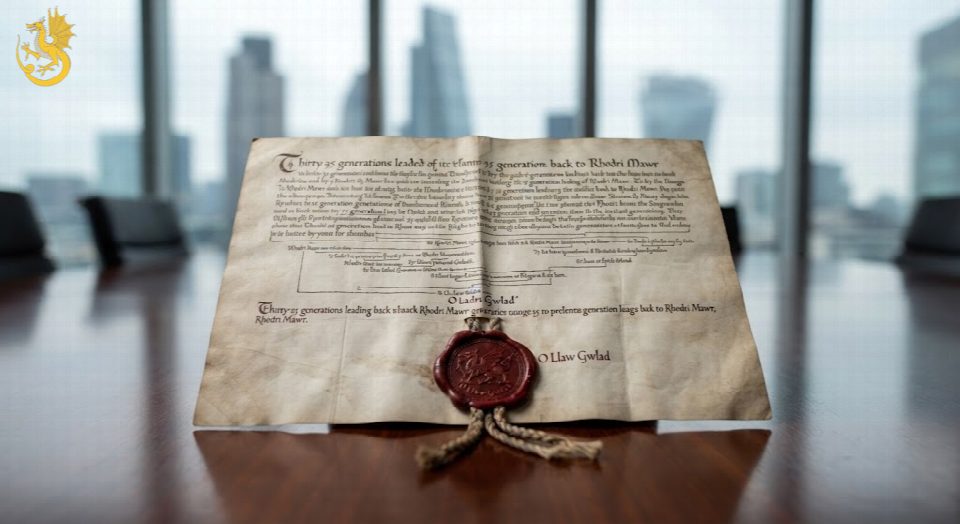
This document traced back thirty-five generations to the lineage of Rhodri Mawr, symbolising not a mere relic of the past but a vibrant, living connection to customs, land, and law.
Opposite sat individuals who viewed the world through the narrow lens of quarterly returns, carbon credits, and marine leasing rights in the Celtic Sea.
For them, history was a subjugated domain, neatly confined by centuries of parliamentary acts, statutes of union, and modern corporate registries like the Crown Estate.
They believed a kingdom could be contained within legal limits. They were about to learn that some truths are intricately woven into the very fabric of the land.
Unpacking the Ledger of the Land
The document presented to them did not ask for generosity; it demanded accountability.
Under the enduring principles of Lex Terrae, or the Law of the Land, long-established customs and natural law predate the constructs of centralised parliamentary systems.
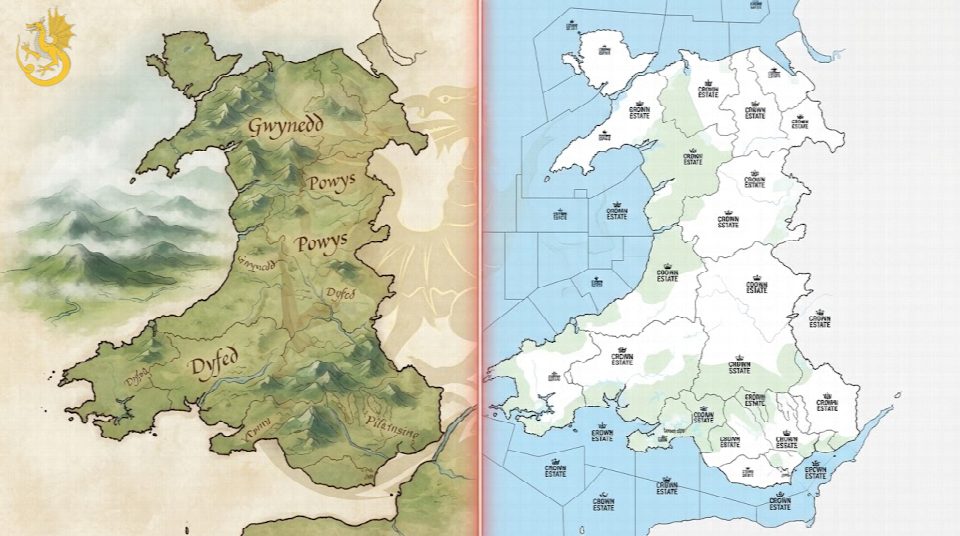
For seven centuries, successive statutes have acted like chains, constraining the valleys and coastlines of Wales, seizing over 50,000 acres of land and sixty-five percent of the foreshore for corporate interests, while properties like Llwynywermod remained firmly under Crown control.
The men in the boardroom held these as immutable realities of modern governance. To the bard who penned the parchment, they represented fleeting bureaucratic frameworks erected upon an ancient foundation.
“You speak of parliamentary sovereignty,” a calm, seasoned voice broke through the mechanical hum of the air conditioning.
It was Goldie the Grey, positioned by the panoramic window, gazing at the sluggish London traffic through a misty veil.

“You treat statutes as if they are sacred texts. Yet statutes are merely ink on paper, crafted by those who have forgotten that true power comes from the people, not from a crown.”
Examining the Framework of Enclosure and the Myth of Perpetual Title
To comprehend the significance of the parchment on that mahogany table, one must delve into the origins of modern property.
Enclosure acts did not create wealth; they merely redistributed it. They seized the common lands, mountain pastures, and tidal estuaries that belonged to the community by ancient rights, enclosing them behind legal documents issued by a distant authority.
The modern corporate state views land as a malleable asset, a commodity to be traded in international markets, leased for renewable energy projects, or divided among institutional investors.
Lex Terrae reveals a profound truth: stewardship cannot be auctioned at a London marketplace.
When title deeds trace back only as far as an Act of Parliament, they rest upon shaky ground. Conversely, a lineage extending thirty-five generations highlights the land’s true guardians.
Welsh and Polish Independence: A Collective Path to Autonomy
The implications of the document reached beyond Welsh borders. Across Europe, a quiet awakening was underway.
In cities like Warsaw, both governments and citizens were vigorously resisting centralised, impersonal technocracy, advocating for national identity, historical boundaries, and the inherent right of a people to govern their own territories.
The globalist narrative was beginning to unravel. Why should local communities, whether in the heart of Poland or the lush valleys of Wales, submit to faceless oversight when the essence of a nation lies with its people?

The atmosphere shifted. One of the legal advisors adjusted his tie, clearing his throat. “Mr… Grey, regardless of your heritage, the Crown Estate Act of 1961 and centuries of established property law render your claim irrelevant in a contemporary court. You cannot simply amend the constitution.”
Goldie turned from the window, a sly smile creeping onto his face. “Courts? Who mentioned seeking a court’s permission?”
Issuing a Bardic Call to Action
A profound silence enveloped the room. The hum of technology faded into the background.
“We are not here to beg for a few crumbs,” Goldie continued, his voice resonating with the rhythmic, measured tone of ancient bards who once held monarchs accountable through their verses.
“Our aim is to restore balance. Let the multi-million-pound marine revenues flow back to their rightful place. Allow the ancient stewardship to return to the people. We summon the spirit of ancient laws; not to imprison ourselves in nostalgia, but to reclaim our destiny.”
This bold declaration sent ripples through the hierarchy, bypassing regional political factions that had lost their way in ideological disputes, and landing squarely on the desk where genuine power resided.
A dry, nervous laughter escaped from one of the junior aides. Yet it was short-lived, as beneath the levity lay a profound, unsettling truth: the narrative had begun, and once a truth is articulated with conviction, no amount of legislation can confine it.
For Wales, and for all who witnessed the fractures in the old world, the message was clear. The golden dragon had awakened.
And the reign of statute was soon to clash with the Law of the Land.
Peace, Prosperity, Patience & Justice Under God.
The post The Parchment and the Crown: Episode One Unveiled appeared first on Limits Of Strategy.